Composing open-ended questions: the full research arc, starting from a picture that outgrows the page.
Starting observation
Draw the -- right triangle. Its hypotenuse is . Now build a new right triangle that uses that hypotenuse as one of its legs: the -- triangle. Its hypotenuse is , so build -- on top of that. Then --. Each rung of the ladder stands on the hypotenuse of the rung below, and every rung is a primitive Pythagorean triple: three whole numbers with no common factor.
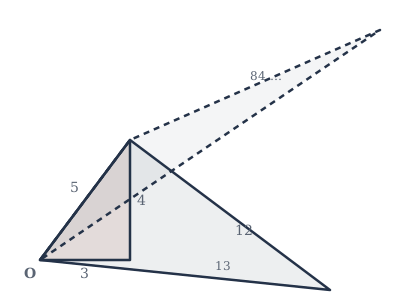
By the third rung the drawing has outgrown the page. Don't read that as a nuisance: the collapse of the picture is the doorway. From here on, the ladder has to be computed.
The research arc
A research question is never settled in one sitting. It moves through four stages, and we lean on a notebook with an AI assistant to write the code, so nobody is blocked by programming:
Query → Data → Pattern → Abstraction
A model chain of questions
- Does the ladder go on for ever? Given any rung, can you always build the next one? Every hypotenuse so far has been odd. Is that an accident?
- Is the next rung unique? Try to find a leg on which two different primitive triples can stand (look carefully at ). If it happens, the ladder is really a tree. So define, for an odd number , the number of primitive triples with as a leg. Have the notebook compute it for , plot it, and guess the rule. What does it depend on?
- How fast does it grow? Climb the tree always choosing the smallest available hypotenuse, and plot the number of digits in the hypotenuse against the rung number. Now climb always choosing the largest. Compare, and explain what a prime leg does to the ladder.
- Where does it go? Draw the ladder as a spiral: every triangle shares the vertex , and the previous hypotenuse is its leg from . What is the turning angle at at each rung? Does the spiral wind round and cross itself, or settle towards a direction? How far can you draw it before it stops fitting on any page?
Your task
Compose one open-ended question of your own, starting from this ladder or from any pattern you noticed in it. Creating the question is the crucial step of the whole research process, and honestly, it is the step teachers are almost never asked to practise. Then sketch how a group of students would carry your question through the four stages of the arc.
Facilitator notes
For the session leader — reveal after the solve phase, not before.
Quiz
2 questions · pass mark 60%. A pass counts towards your certification.