Finding High-Potential Learners: a session with ICSE teachers in Kolkata
Dr. Ashani Dasgupta worked through four rich tasks — one per tier of the classroom-to-research pyramid — with ICSE school teachers in Kolkata.
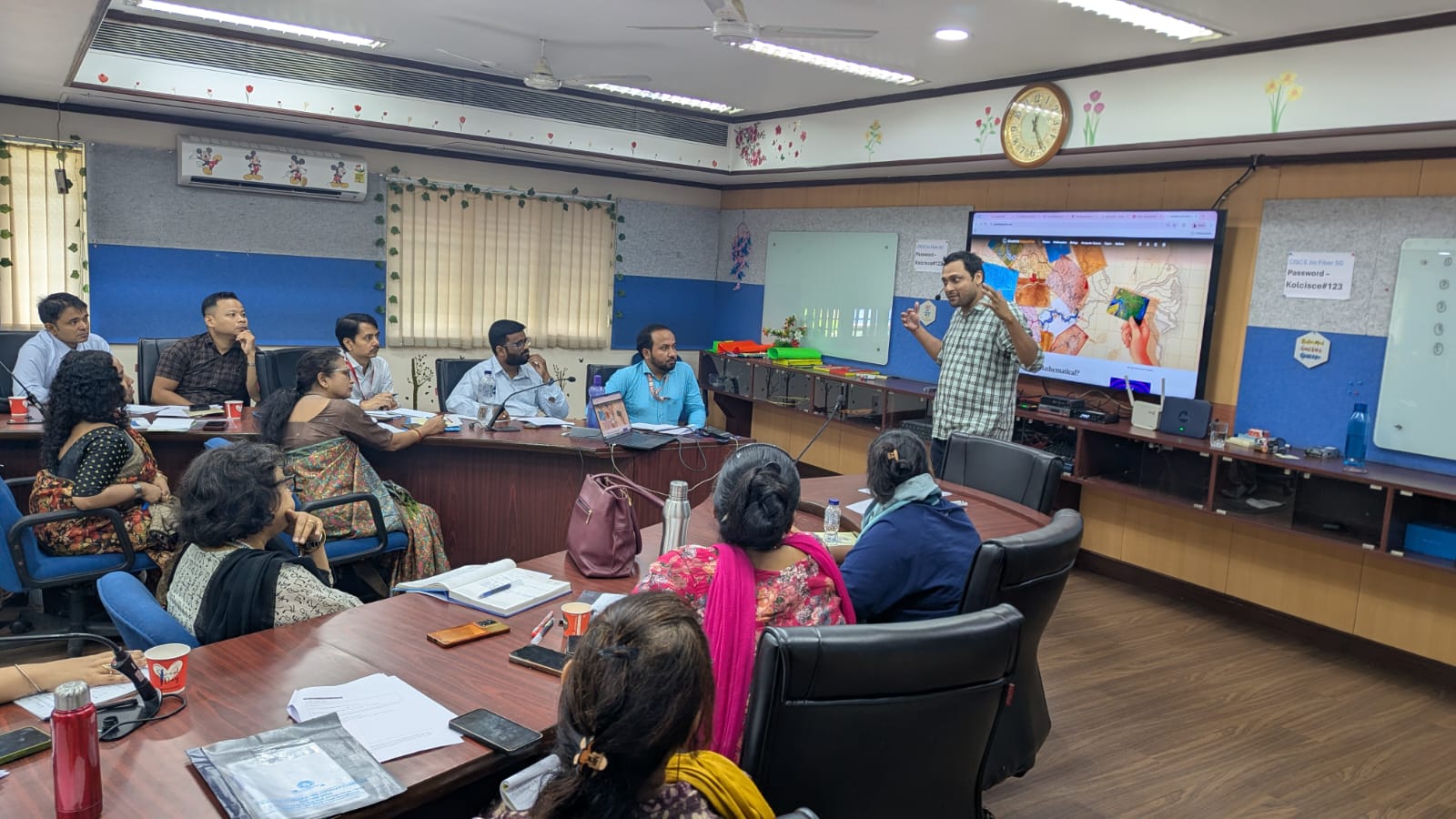
Dr. Ashani Dasgupta recently led a three-hour session with ICSE school teachers in Kolkata on two questions that turn out to be one: how do we find our strongest young thinkers, and how do we design tasks rich enough to reveal them?
One craft, seen from two sides
The most reliable way to identify a high-potential learner is to place a genuinely rich problem in front of the whole class and simply watch. A rich task has a low floor, so every child can start, and a high ceiling, so the strongest thinkers reveal themselves — through persistence, through generalisation, through the questions they ask next. Identification and task design are the same craft.
Every segment of the session followed the same rhythm. First the teachers solved — sitting with a problem exactly as a student would, with real workspace and real time. Then we dissected it together: what does the task demand, why does it belong where it does, and what does it let a teacher see?
The four-tier pyramid
The journey from an ordinary maths class to genuine research runs through four tiers, each handing the child to the next through a visible signal:
- The Open Math Circle — a weekly list of syllabus-free problems for every class from grade 3 to 10, and an open circle where any child may present on the board or submit a written solution. The board catches the communicators; the written channel catches the shy strong thinkers we lose far too often.
- The Specialized Math Circle — small mixed-age groups (ability, not age, sets the peer group) that discuss curated problems and publish a monthly solution set of their own.
- Olympiad and Research Training — twice-weekly accelerated work on two tracks: structured Olympiad modules, and open-ended problems that mature into faculty-led research headed for science fairs and high-school journals.
- The enrichment layer — journal articles, laboratory equipment, advanced problem sets, and books by working mathematicians and scientists, which tip training into genuine idea generation.
The four worksheets
The packet climbed a deliberate ladder, one problem per tier — and each is now a resource on this site, with its facilitator notes and quiz for signed-in teachers:
- The Thousand Doors — elementary but hard; noticing structure, no formulas.
- The Difference Game — elementary but deeper; inventing an invariant.
- The Cyclic Sum — thinking plus technical machinery; a named theorem.
- The Prime Producing Polynomial — composing open-ended questions; the full research arc, Query → Data → Pattern → Abstraction.
What comes next
Teachers who want to go further can sign in, work through the resources, and start the certification journey — Advanced Mathematics Trainer, in three levels, each combining sustained engagement, resource quizzes, and an interview.
The session was delivered by Dr. Ashani Dasgupta (Cheenta Academy) in collaboration with Lilavati.
Comments
Sign in to join the conversation.